The time passes by, and with it passes by the moments, no matter how hard you try to hold on them, Time ruthlessly erases the moments, leaving behind just the memories. If the present is beautiful enough, you don’t miss your past much. But the hit of the first pang of the day, and there you are, crying for the days gone. I believe nothing can be more painful than the hit of nostalgia. It leaves you crying and craving for something that you can never get at any cost. And the realization of the very fact increases the pain. You do know that it is not possible to get back to the moments that are gone, but still you long for them as if your wish would come true. Here, I feel the urge to say that really ‘ignorance is bliss’. To not know the truth at least leaves the hope in our mind that it could happen. But to know is to lose the hope.
Here I am, missing the past, missing my long gone childhood days which are not going to be back again. I know I won’t be able to relive them and again the knowledge is tough to digest. I visited my village recently and the visit was not a pleasant one. I planned the visit thinking that it would transmit me back to the old days. The days when I, with my cousins, used to play whole day. Without any stress, without any acknowledgement of the coming Future, we used to play day in and day out. There was just the school homework and games, eating and playing was our routine. Nothing could stop us from running tirelessly in the fields, without our chappals. Everything was a game to us, everything a matter of fun, and excitement. Someone is getting a well dug, we ran to have a look, and later to play with the mud left out of the well. If a house is getting ready, there we are, playing hide and seek in the half-built house. The fields with crops like peas, corn, sugarcane, cucumber etc., could not remain untouched by us. We were like prince and princesses of our village and were equally respected by the villagers. They used to call us “chhoti panditain” and “chhote panditji” and we used to get annoyed by this gesture. Some used to tease us, calling us horse and tiger, as we used to run along the roads, through their houses, through the fields. The whole village, including the houses was our playground. Then there was dadi, our grandmother, who used to apply every technique to keep us home. She and her pressing us for food. She was always ready with enough food in her plate to feed us. Following us everywhere, she used to shout our names. She never liked us running everywhere. Sometimes she used to get sticks to scare us so that we could listen to her. But who could stop us. We were far more cunning than she thought we were. We used to make plans in English in her presence and when asked, told her that it’s our homework. She, rather everyone in the village, had this habit of having naps during the afternoon hours, after the meal. That was our golden hour. We used to sneak away, out on the fields, to have the tour of the village, when everyone’s asleep. It was pure adventure to us. We used to climb the trees, jump into the pits, walk on the walls, swing on the branches, eat whatever we get, be it baby leaves or raw fruits and vegetables. Then there were our friends, although younger than all of us, still we played together. Everyone was friend, everyone was a relative. Some called us bua, some didi, some maasi. But it never bothered us. We played, did cheatings, fought with each other, pushing each other in the soil, and again playing together. We even sometimes used to bring eatables from our homes, in order to celebrate a small picnic. I still remember how we used to talk to dadi to get her into our plan and get one or two rupees from her. We mostly got one rupee and that was enough for the four of us. But lucky were the days when she gave us two rupees. That day was party for us. The feeling was of earning the world and we used to celebrate like anything. I, being the eldest of all, was the in-charge. And it was my duty to see that everyone gets equal share of whatever we get. But I had my ways. Since others were younger kids, it was sometimes difficult for them to tear the packets or get off with the wrappers. So it was again my duty to do that for them. There comes my idea, of getting a portion of their share which I used to call bakhshis for doing the job for them. It was so much fun. The storms which made everyone else run inside their houses used to work its opposite for us. The first sign of storms used to make us leap out of our houses. We kids ran out in the strong wind and heavy rain to enjoy every blow of it. The aftereffects of the storm was even more rewarding. Raw mangoes, litchis, wild berries, imli and other such things were the gift of nature to us, we believed, for enjoying the storm. Floating paperboats is a cliché and need not be mentioned. I assume everyone know the joy of floating boats made out of the paper torn from school notebooks, which sometimes turned out to be the important notes which made us suffer later. Everyday was festival when I was a kid. But now, even the festivals fail to bring such joy.
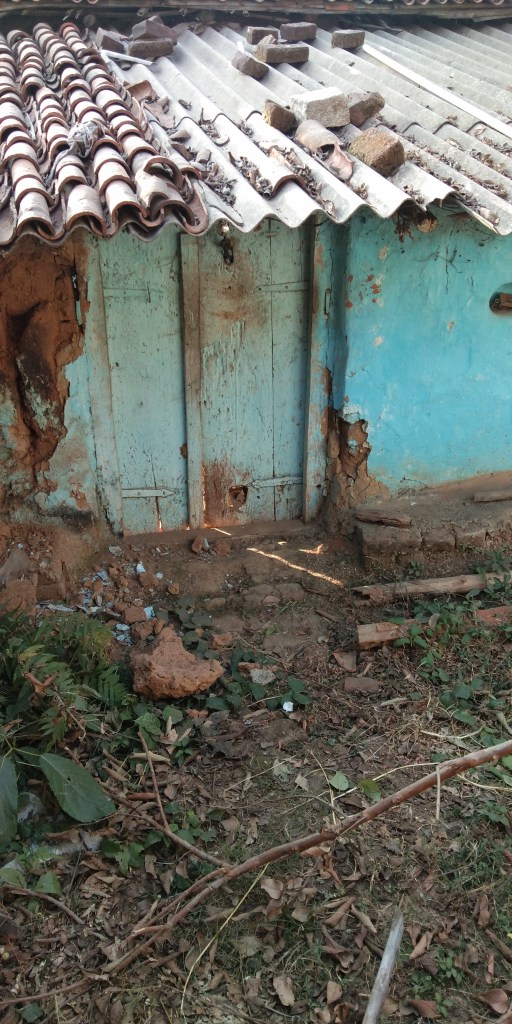
The revisit, as I mentioned, was not a pleasant one. As soon as I entered the village, instantly I realized that the decision was not right. I should not have come here, not now. At least the memories of the village was a sooth to me and I could enjoy those whenever I wished by just remembering the childhood days. But now, after this visit, THE things are going to change. The new images would get pasted over the older ones. The very house where I spent my best of the days was no more the same. Instead I found a well-built cemented house with several rooms. It’s not that the new house was built over and in the place of the older one. That old kachcha house was still there, but in a condition that gave no comfort to eyes when entered. The entrance was stooped so low that anyone can hardly enter from there. So from where we were supposed to enter the house? It was through the side wall that was lying down, one with the soil. Yes, the house was collapsed! It was dilapidated, lying down helplessly, just like a person who is old and not taken care of. The cheerful varanda where we used to enjoy our meals was no more cheerful. Rather it was more like a field full of dust and soil. The kitchen is no more visible as it got mixed with the other fallen walls. The room which belonged to dadi, where we used to spend our nights whenever we stayed there was lifeless, left ignored. My heart broke at that cruel sight. It was just unbearable.
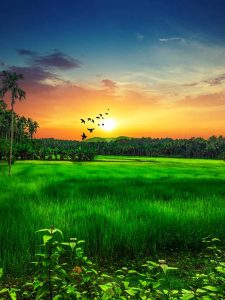
When I moved ahead, I found that even the other houses of my village were not the same. It was like a complete transformation. Mostly two-storied houses took the places of all of the kachcha houses that I was so proud of. Those older houses spoke love, unity, simplicity, a connection with the nature, the earth. Those were even very comfortable with all of the needs covered. The nearby wells with ‘oh, so cold’ water, THE green fields bearing various crops, the vastly spread aangan, the gatherings of people under the trees… All of these were missing and I more than ever regretted my decision. Even the people with whom we grew up, those bhaiyas, bhabhis, chachis, dadis, friends, most of them were not there. I got to know that they moved out of the village to some better place.
Now the kids no more run around the village, as they have better things to do (obviously, they have smartphones and T. V.). The elderly people no more gather under the trees, for there are not much trees as well as elders. No more matkas get filled with the cool water of well, every house has motor fitted taps. My village lost its soul.
I understand that change is a must but a change this dramatic! I returned to my home and convinced myself that the older village is a past as is my childhood and I can never go back to it, except through my memories and sometimes… through my dreams.